Meet Dahlia

Dahlia Sengupta

Ancient perspectives. Modern thinking. Practical transformation.

Born in India and now based in Houston, Texas, Dahlia Sengupta brings a lifetime of learning to Spira & Sage. Her work joins the careful analysis of her father and grandfather with the intuition, culture and faith of her mother’s family. Today, she shares that connected perspective with people around the world.

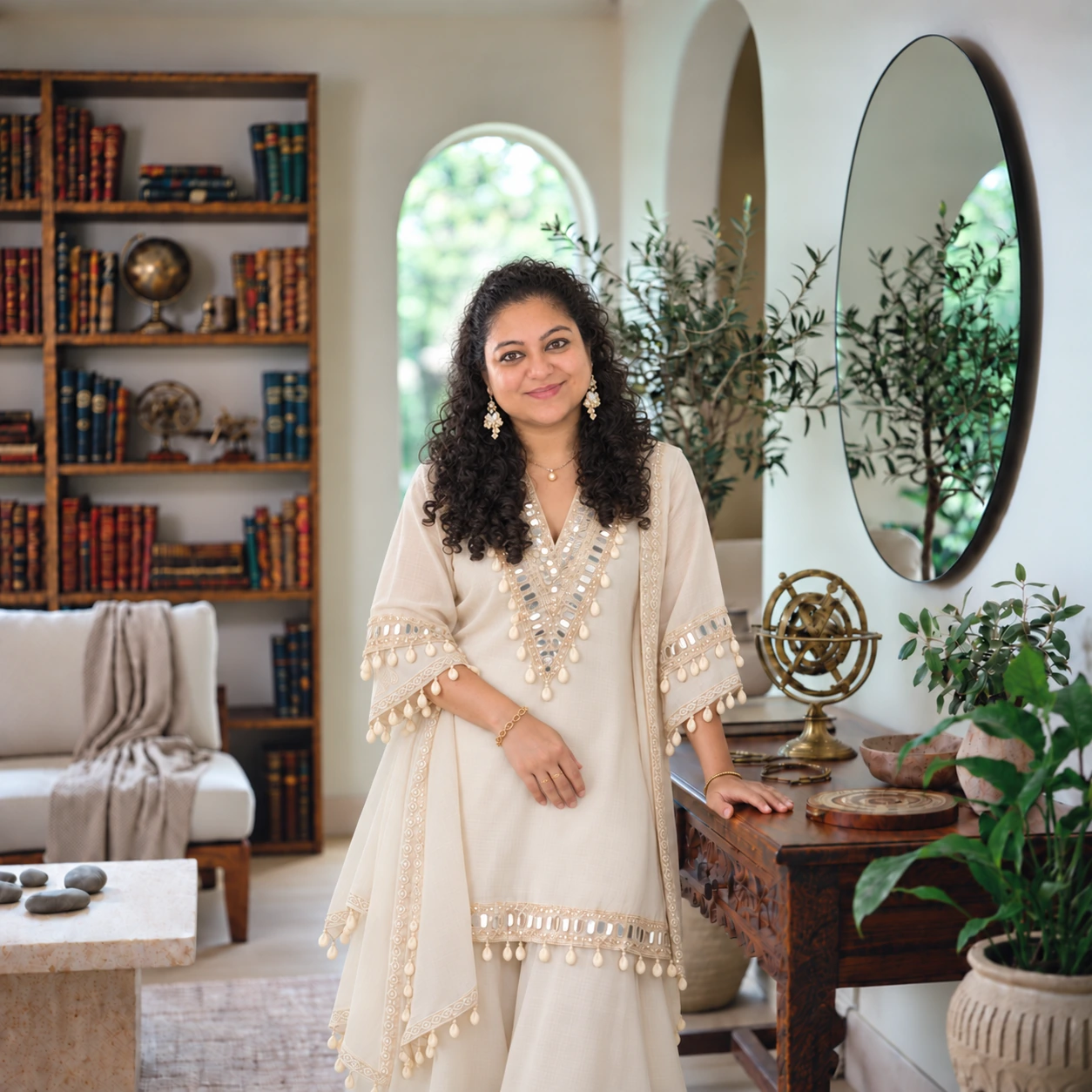
Dahlia welcomes visitors in a light-filled consultation room with an arched mirror and brass instruments
Role
Consulting practitioner, Spira & Sage
Roots
Born in India · Based in Houston, Texas
Practice
Consultations with clients worldwide

Roots

Two inheritances, one way of seeing

Dahlia began learning astrology, numerology, Vastu Shastra and palmistry at seven or eight years old. These traditions were part of her childhood, long before she imagined a professional practice.

Her father and grandfather: the analytical foundation

Her father and grandfather were deeply comfortable with mathematics, calculation and patterns. They were locally known for astrology, numerology and Vastu, as well as palmistry and face reading. Their work gave Dahlia a foundation in structured analysis and close observation.

Her mother’s side: intuition, culture and faith

From her mother’s side came a strong connection to intuition, tradition, culture and faith. Dahlia grew up where these influences met the analytical approach of her father’s family. She understands her intuitive gift as an inheritance from her ancestors, nurtured through learning and experience.

The long apprenticeship

Decades of learning, one layer at a time

A child testing her own predictions

As a child and teenager, Dahlia practised quietly inside her extended family. She made observations, offered predictions, and watched how dates and events actually unfolded. Some were strikingly close. Others were not, and those were the useful ones: she went back, compared the reading against what happened, and looked for where her reasoning had bent. Observe, test, revisit, refine — that habit is still how she works.

Learning one system before the next

Starting young gave her the one thing that cannot be acquired later: time. Time to learn a single system, live with it, question it, and only then take up another that added a dimension she had been missing. A pattern in a chart could be weighed against a numerological one, or against the room a person sits in all day. Vastu raised questions Feng Shui answered differently. A traditional recommendation could sit beside a habit, a colour, a scent, a plant, a herb, an object. The depth comes from the years between the disciplines. Tarot and auspicious timing also form part of the traditions she brings to her work.

Formal training and continued study

More recently she has pursued formal professional training and certifications to sit alongside what she absorbed informally. The combination matters to her: traditional knowledge gives depth, formal study gives structure, modern life gives context, experience gives perspective. She keeps studying because she does not think anyone honestly reaches the point of saying they know everything there is to know.

Professional experience

What the boardroom taught her

Dahlia also brings a professional life in consulting. She served as a VP at consulting companies, working across transformation, data, technology and AI, with broad experience working with C-suite executives.

Her consulting background complements the perspective she inherited from her family. It brings a structured way of exploring a question while keeping its human context in view: the responsibilities, relationships and choices that make each person's situation different.

Listening
Hearing what sits underneath a question, not only the words used to ask it.
Structuring
Turning a tangled situation into a few questions worth answering.
Clarifying priorities
Separating what is urgent from what simply feels urgent.
Translating complexity
Turning analysis into a next step someone can actually take.

Method

How she reads a situation

Dahlia's method grew out of her family's without staying identical to it. She calculates the traditional indicators as her father and grandfather did, then steps back to pay attention to what she senses about the circumstances surrounding them.

Which possibility appears stronger? Which seems temporary? What is changing, and what remains consistent? What does the person reveal through their behaviour and circumstances? These questions help her put the calculations in context.

  1. Calculate

    Build the charts, numbers and placements carefully, without deciding in advance what they will mean.

  2. Observe

    Look at the person, the environment and how they actually behave day to day.

  3. Question

    Ask what the indicators might miss, and what another tradition would say here.

  4. Feel

    Notice what the circumstances convey beyond the calculation, and take that seriously.

  5. Compare

    Set the readings side by side; note where they agree and where they diverge.

Dahlia in ivory guiding a smiling couple during a consultation in a sunlit room

Why Spira & Sage

From a private practice to a wider one

For most of her life this stayed the private part of Dahlia's world. She kept learning, kept questioning her own interpretations, and worked mainly with family and people close to her. What changed was her sense of who else it could serve. She co-founded Spira & Sage to take that connected way of looking beyond the family circle — not as a substitute for professional advice, not as a request for belief, not as a promise of fast transformation.

Her interest had shifted too. Predicting what might happen became less interesting than asking what a person can do with the information. So the work looks at the whole picture: the person, their circumstances, their environment, the choices actually available. When several independent traditions point at one theme, it earns closer attention. When they disagree, that is useful too — it keeps a single interpretation from hardening into an unquestioned conclusion.
In practice

Awareness matters when it becomes action

What she recommends is usually small, specific and possible this week. Insight that stays in the head changes nothing; the point is the action it makes available.

Routine
A difficult stretch at work becomes a reason to change a routine rather than endure it.
Space
A stagnant workspace or home gets reorganised — furniture moved, light reconsidered, a colour introduced.
Five minutes
Someone overwhelmed begins with five minutes of intentional breathing, and nothing more ambitious.
Sensory anchors
A scent in a morning ritual; a crystal, gemstone, herb, essential oil, candle or bath salt as a reminder. Tools, not requirements.
A postponed goal
One small action toward the thing that has been waiting, taken rather than planned again.
Attention
Deliberate attention to something in your own life that has long been overlooked.

None of this runs on fear. Dahlia does not believe anyone should be told that something terrible is coming unless they buy a remedy. Her first question is what this person can realistically do; sometimes the answer costs nothing, takes five minutes, or means changing one habit. If a product or additional service could help, she explains why and what it costs. The aim is to make a person more able to direct their own life.

Across cultures

Texas now, many places before

Dahlia has lived and travelled extensively across India, North America, Canada, parts of South America and Europe. She now lives in Texas with her husband and their two young children.

Living across cultures reinforced something she holds firmly: there is no single route to personal change. A practice that feels natural to one person can sit badly with another's culture, religion or values. Recommendations therefore take account of cultural background, personal beliefs, religious considerations, lifestyle, family circumstances, physical environment, time available, financial comfort and personal preference. The goal is never to impose a system, only to find one a person can live with.

Don't take our word for it. Observe your own life.

People arrive from very different directions. Some with deep faith, some because someone they trust recommended her, some out of plain curiosity, and some as outright sceptics — often the most interesting, because scepticism observes without surrendering judgment. A CEO does not have to become a believer, a CFO does not have to understand every system, a scientist does not have to accept a metaphysical explanation, and a busy parent does not need another complicated routine.

There is no need to change your religion, abandon science or agree with every explanation behind a practice. So start with one small thing. Give it your attention, do it consistently, and observe. Keep what works and question what doesn't. If it doesn't resonate you have learned something; if it does, you have learned something else. Either way the decision stays yours, and the most convincing transformation is the one you experience yourself.

Working with Dahlia

The commitments that shape every session

Preparation, plain language and your own authority. These hold in every consultation, whatever tradition it draws on.

Room for your own choices

A chart describes tendencies and seasons. It does not sentence anyone to anything, and it will not be presented to you as though it does.

Care, without fear

Dahlia does not read death, does not predict disaster, and does not use alarm to sell a follow-up. This is the single firmest rule in the practice.

Words you can understand

Sanskrit and Chinese terms are used where they are precise, and explained the first time they appear. You will never be made to feel outside the conversation.

Preparation before you arrive

Charts are calculated and floor plans studied in advance. The hour you pay for is the hour you get.

Something practical to take away

Every session ends with something specific — or with a clear statement that nothing needs doing yet, which is sometimes the honest answer.

Honesty about the limits

Where a question belongs with a doctor, a lawyer, an accountant or a therapist, she says so.

Before you book

Your questions about training belong here

Choosing a practitioner is personal. Take the time to understand the approach.

Ask about training, how the traditions are applied, and what a consultation can—and cannot—offer.

If you would like details of Dahlia’s training or approach, include those questions in your inquiry before deciding whether to book.

Begin a conversation with Dahlia

A sentence about what is unresolved is enough to start.